After years of incarceration, post-conviction litigation revealed that the original trial was tainted by a Brady violation—one of the most serious forms of prosecutorial misconduct. What followed was a hard‑fought legal battle, the granting of a Writ of Actual Innocence, and ultimately, a retrial.
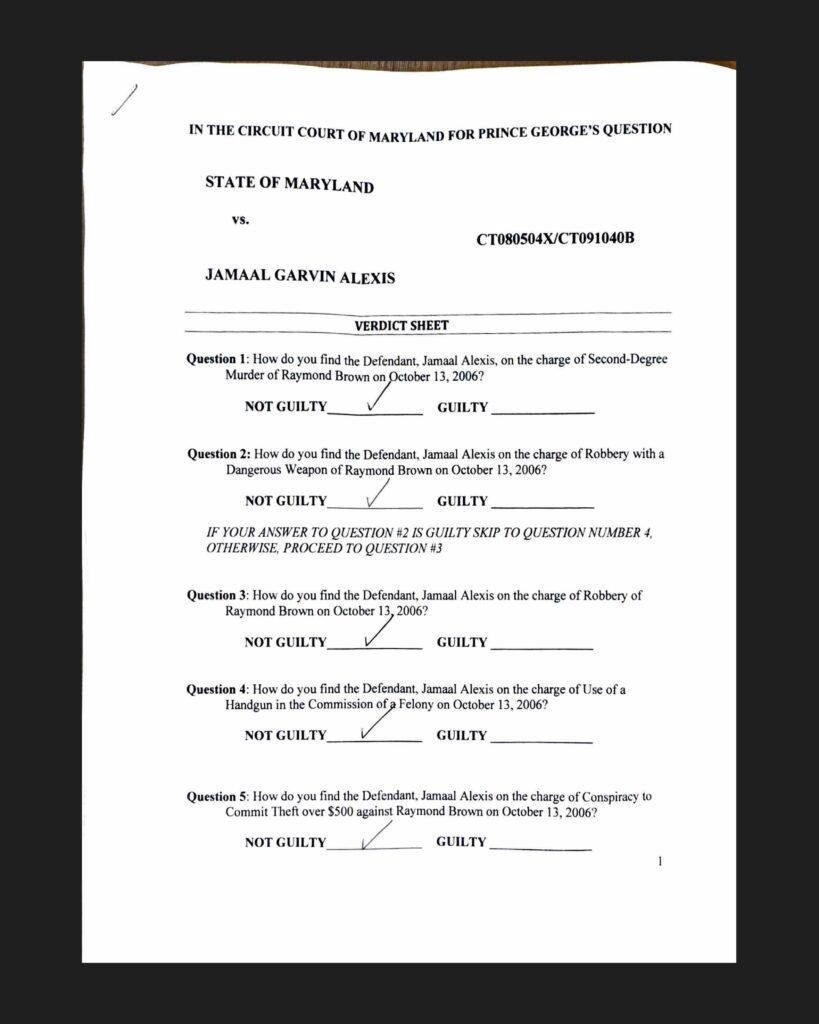
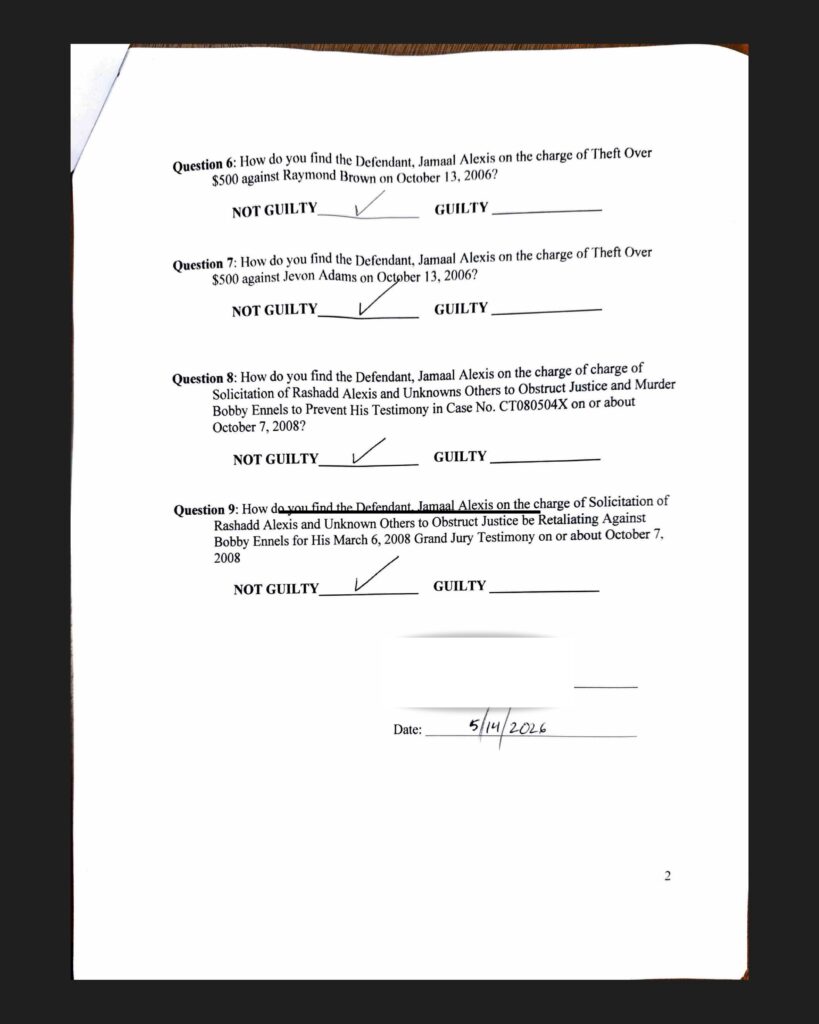
At that retrial, Seddiq Law secured a not guilty verdict, bringing long‑overdue justice to a case that had been fundamentally flawed from the start.
- Jamaal Alexis Case Time Line
- Maryland Law for Petition for Writ of Actual Innocence and Judge Alves Order Granting the Petition
- Witness Promised Benefit Jury Instruction
- The Prosecutors Had from 2022 to 2026 to Prepare for Retrial
- The State Calls it an an "alleged" Brady Violation
- The Retrial: Presenting the Full Story
- The Verdict: Not Guilty
- Seddiq Law’s Commitment to Justice
- Contact Seddiq Law
Jamaal Alexis Case Time Line
It was widespread in the news that music producer Scott "Beats" Brown was killed in October of 2006. His death was a tragedy. Three young people at around 2:30 in the morning had brought a tow truck to where Mr. Brown's car was parked and attempted to steal it without anyone knowing the better. Startled, whoever was driving the tow truck, shot Mr. Brown once and he died from his injury.
A follow-up article will be written discussing more details of the case. But for purposes of this article we are trying to simplify things. After the killing, two other young men were arrested for murder in the case of Mr. Brown. It was not until early 2008 that Jamaal Alexis was charged with murder of Mr. Brown also.
These two young men engaged in plea agreements to avoid murder charges in the case, despite the fact that is what they were originally charged with.
Tragically, one of these persons, Bobby Ennels, was killed in 2008. The state alleged that the witness was killed in retaliation for him cooperating, or perhaps killed to keep him from testifying at trial.
Jamaal Alexis faced at a joint trial the murder and related charges for Mr. Brown in 2006, along with the conspiracy to murder this former co-defendant turned state's witness. This trial lasted for a month in October 2010.
The State was represented by prosecutor Wes Adams and Dorothy Engel. After this original trial, the verdicts were as follows:
CT080504X (Scotty Beats murder case) acquitted Alexis of one count of first-degree murder of Raymond Brown, one count of first-degree felony murder of Raymond Brown, one count of carjacking of Raymond Brown, and one count of armed carjacking of Raymond Brown. Jury convicted Alexis of second degree murder and robbery with a dangerous weapon of Raymond Brown, use of a handgun in the commission of a crime of violence, common law conspiracy to commit theft over $500, and two counts of theft over $500.
CT091040B (witness conspiracy murder case) acquitted Alexis of one count of conspiracy to murder Bobby Ennels, one count of obstructing justice by preventing testimony of Bobby Ennels, and one count of obstructing justice by retaliating against Bobby Ennels. The jury convicted Alexis of solicitation to commit the murder of Bobby Ennels to prevent him from testifying in case number CT08-0504X, and solicitation to commit the murder of Bobby Ennels in retaliation for testifying before the grand jury.
Importantly, at this trial, there was no forensic or physical evidence tying Mr. Alexis to these crimes. The entire case relied on the testimony of cooperating witnesses, or witnesses who perceived a benefit to cooperating.
After losing his direct appeals, Mr. Alexis, through other counsel, filed a Petition for Writ of Actual Innocence. This petition is allowed for those who have been convicted and believe there was critical evidence they did not have at the time of their conviction.
It should be known that from his original conviction, through his years of appeals, and then his petition for writ of actual innocence, the State was on notice that there were serious issues at play and that, because Mr. Alexis had not exhausted all of his options, great care should have been taken by them to preserve any evidence in the case.
Maryland Law for Petition for Writ of Actual Innocence and Judge Alves Order Granting the Petition
The most singularly helpful document in this case, both to understand the history of the case up until the retrial, and to understand the Brady violations, is the Statement of Reasons and Order of Court, drafted by the Honorable Judge Alves, and signed on June 21, 2002.
For ease of use, we have embedded that order here below.
Basics for Petition for Writ of Actual Innocence.
Under Maryland law, a Petition for Writ of Actual Innocence allows a convicted individual to seek a new trial based on newly discovered evidence that was not available at the time of trial and could not have been discovered through due diligence.
To prevail, the petitioner must satisfy three key requirements: the evidence must speak to actual innocence, it must truly be newly discovered, and it must create a substantial or significant possibility that the result would have been different if presented to the jury. See Md. Rule 4-331 and Hunt v. State, 474 Md. 89 (2020).
Judge Alves Finding of Brady Violation and Likelihood that this Unknown Information Could have Influenced the Verdict in 2010.
In granting the Writ of Actual Innocence, Judge Alves made a clear and forceful finding that the State violated its constitutional obligations under Brady v. Maryland. The court concluded that the prosecution failed to disclose critical impeachment evidence—specifically, that a key witness received a significant reduction in his federal sentence tied to his testimony—evidence that should have been provided to the defense.
Judge Alves rejected the State’s position and found “the significant reduction in Barnes’s federal sentence constitutes newly discovered impeachment evidence under Brady,” further holding that “the evidence was material to the impeachment of Brian Barnes, and its non-disclosure by the State prejudicially impacted the Petitioner.” This passage from the order says it all:
There was no physical or forensic evidence linking Petitioner to the murder of Raymond Brown or Bobby Ennels. Barnes's testimony was the only testimony presented that did not carry the barnacle of
the State's grant of leniency for its witness testimony. Accordingly, this Court finds that Petitioner has met his burden establishing that there is a substantial or significant possibility that the result may have been different had the State upheld its duty underBrady to disclose the impeachment evidence.Alves Order, p. 35.
The opinion emphasized just how central this witness was to the prosecution’s case. As the court observed, prosecutors themselves viewed the witness as a “‘but for’ witness in the conviction,” meaning the case may not have succeeded without his testimony. At the same time, there was no physical or forensic evidence linking the Petitioner to the murders, making credibility the decisive issue for the jury.
Judge Alves made clear that the withheld evidence went directly to that credibility. The court explained that “a jury, aware of the significant sentencing benefits given to Barnes, could reasonably give less or no weight to his testimony.” This finding struck at the heart of the original conviction, where the jury heard testimony presented as coming from a witness with no incentive to lie.
Ultimately, the court concluded that the nondisclosure undermined the fairness of the trial and satisfied the core legal standard for relief, finding a “substantial or significant possibility that the result may have been different” had the evidence been disclosed. That conclusion was decisive—confirming that the 2010 verdict could not stand and paving the way for a retrial where the full truth could finally be presented.
Witness Promised Benefit Jury Instruction
After a jury hears the evidence in a trial, but before they go back to deliberate, they are given instructions on the law. Some are obvious like instructions on what the prosecutor has to prove for each crime and instructions on what reasonable doubt means. Others, specifically important in this case, include the "Witness Promise Benefit" instruction.
This is a court instruction that literally urges jurors to urge caution when considering testimony of witnesses who, not just have a formal plea agreement to cooperate, but also if the witness perceives a benefit if they cooperate or testify. Here is the exact jury instruction below.
You may consider the testimony of a witness who [testifies] [has provided evidence] for the State as a result of [a plea agreement] [a promise that he will not be prosecuted] [a financial benefit] [a benefit] [an expectation of a benefit]. However, you should consider such testimony with caution, because the testimony may have been influenced by a desire to gain [leniency] [freedom] [a financial benefit] [a benefit] by testifying against the defendant.
See (MPJI-cr 3:13)
This type of jury instruction is logical. As humans we, when determining whether to engage with someone in day to day activities, we look to a person's motivations before we go forward with those people. If, for example, we are buying a car, if the salesman has a price that is "too good to be true" and the sales history of the car is murky, you very likely may not buy that car from the person.
As applied in this case, Brian Barnes had a plea agreement deal in federal court to cooperate in the state murder trial against Jamaal Alexis in 2010. He was facing two life sentences for serious federal charges. He escaped serious punishment for cooperating with the federal prosecutors. The jury should have known about that in evaluating Mr. Barnes credibility at Jamaal's original trial in 2010.
The Prosecutors Had from 2022 to 2026 to Prepare for Retrial
Judge Alves granted the motion to vacated Mr. Alexis convictions almost four years ago. This is relevant because in recent media cover in the Baltimore Sun, the State insinuated that they lost the trial due to old evidence. Here is the quote from the Sun:
In a written statement, the Prince George’s County State’s Attorney’s office acknowledged that a Circuit Court judge granted a defense motion for a new trial based on an “alleged” Brady violation. “Prosecutors retried the case last week using evidence that was nearly 20 years old, and Alexis was acquitted of all charges related to Brown’s murder.”
Baltimore Sun, May 19, 2026, Ruben Castaneda, Man acquitted in retrial of hip-hop producer murder after spending 18 years in prison
At no point prior to the re-trial did the State inform this defense counsel that any evidence was missing. During trial, the prosecutors, for example, refused to admit that any DNA evidence had been lost. The only evidence they admitted to losing (either them or the police) was a recording from a wiretap done at the jail to overhear conversations between Mr. Alexis and his visitors after Mr. Ennels was killed.
And, to be clear, the State did not admit to losing these recordings literally until the moment a former detective, Sean Cheney, was about to take the stand during recent retrial. He was allowed to testify despite current counsel not having the chance to review the recordings, nor the jury having the chance to hear the recordings, the Detective was allowed to testify as to things he allegedly heard on these calls.
The State before trial never shared with defense counsel that it had lost any evidence. For the State to now blame their loss on "evidence that was nearly 20 years old" is simply opportunistic. They could have said we can't retry this case because of missing evidence x, y, z. Or at least make this proclamation before they lost the case.
The State made several decisions to not call key witnesses at the retrial such as lead Detective Olds and Brian Barnes. The State had access and opportunity to secure subpoenas for all of their witnesses.
In fact, for one of their cooperating witnesses, Amadu Jalloh, their efforts were so deficient that the Court would not agree to an unavailability finding. If the judge had granted the motion, the State would have been allowed to introduce his original testimony in the case. See Md. Rule 5-804(a)(5).
The State Calls it an an "alleged" Brady Violation
As shown above, the State proclaims that the Brady violation here is merely, "alleged." We are going to explain why this is not an appropriate use of that word.
Allegations are claims made against someone in court. You stole something, you hit someone, you killed someone, the prosecutors failed to disclose Brady evidence, etc.
Something changes from an allegation into a non-allegation with a jury or court makes a finding after reviewing evidence and the law.
That's what happened here. Mr. Alexis made an allegation that the State committed a Brady violation. There were legal filings, testimony taken, and finally a detailed ruling by the judge. Judge Alves found there to be a Brady violation and found that it likely would have impacted the jury's decision.
After that order in 2022, these Brady violations were no longer "allegations", they were judicial findings of fact and law.
The Retrial: Presenting the Full Story
When the retrial began, everything changed. Seddiq Law was retained in November of 2025.
Because of a need to get a judge assigned to the case, defense counsel did not get discovery from the prosecutor until about two months before trial.
For the first time, the defense was able to present a complete and accurate narrative—one that included the evidence that had been previously withheld. Defense counsel Eisele applied years of experience and carried theory his theory of the case from opening statement all the way to a careful, forceful, and deliberate closing argument.
This case was about "3 things"
- No forensic or physical evidence dying Jamaal Alexis to these crimes
- No legitimate identification of Jamaal Alexis at any of these crime scense
- And no state witness that could prove this case for them that was not compromised by their own motives to avoid murder charges, desire to get a sentence reduction, history of untruthfulness
Key Defense Strategies at Jamal Alexis Retrial
- Reframing the Case Narrative
The defense reconstructed the timeline and presented an alternative explanation of events consistent with innocence. - Cross-Examining Critical Witnesses
Witness credibility was directly challenged, particularly where undisclosed impeachment evidence existed. Because of the serious nature of the case, defense counsel was deliberately focused but also deliberately kind to witnesses, despite issues with their crediblity. - Exposing Investigative Gaps
The defense demonstrated how the investigation failed to pursue leads or evidence inconsistent with the prosecution’s theory. It was clear as the trial evidence developed, that there was no explainable reason why Detective Olds arrested Alexis after so much time was passed. And, one of the original cooperating witnesses changed his testimony at the retrial and said he only fingered Jamaal Alexis under threats and duress from Detective Olds. Detective Olds was definitely around. This defense counsel called and spoke to him and emailed with him. He was available. The State chose to not call him. - Creative Presentation of Evidence
During the original trial the State tried to interpret discussions Mr. Alexis had with his friends into being some elaborate code for killing Mr. Ennels. The defense strategy was to trust the jury. During closing argument almost eight minutes of one of these calls was played. It was clear that the call had nothing to do with soliciting murder. Building trust with the jury, and. then trusting the jury is a core practice at Seddiq Law. It pays off.
The Verdict: Not Guilty
After hearing the full case, the jury only deliberated for two hours on May 13, 2026.
Not guilty.
This outcome was not just a legal victory—it was a restoration of justice after nearly two decades. It validated the importance of post-conviction advocacy and demonstrated the impact of a fair trial conducted with all evidence on the table.
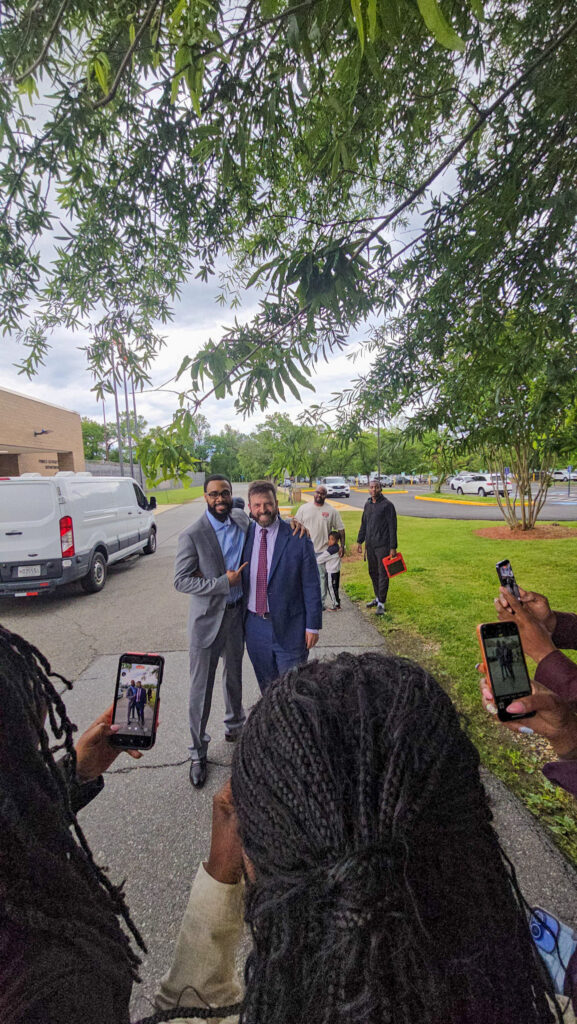
For about four ours Mr. Eisele sat outside the PG Jail to wait for Jamaal to walk out after all these 18 years. It was a special moment.
Seddiq Law’s Commitment to Justice
At Seddiq Law, cases like this reflect a broader commitment:
- Protecting constitutional rights
- Investigating cases beyond the surface
- Fighting wrongful convictions
- Advocating for clients at every stage—from trial through post-conviction relief
Complex cases involving Brady violations and actual innocence claims demand a deep understanding of both trial advocacy and post-conviction strategy. That experience made the difference here.
Contact Seddiq Law
If you or a loved one believe a conviction involved withheld evidence, constitutional violations, or wrongful prosecution, you may have options.
Seddiq Law is ready to help. Contact us today to discuss your case and explore your legal rights.